A Straw on a Path
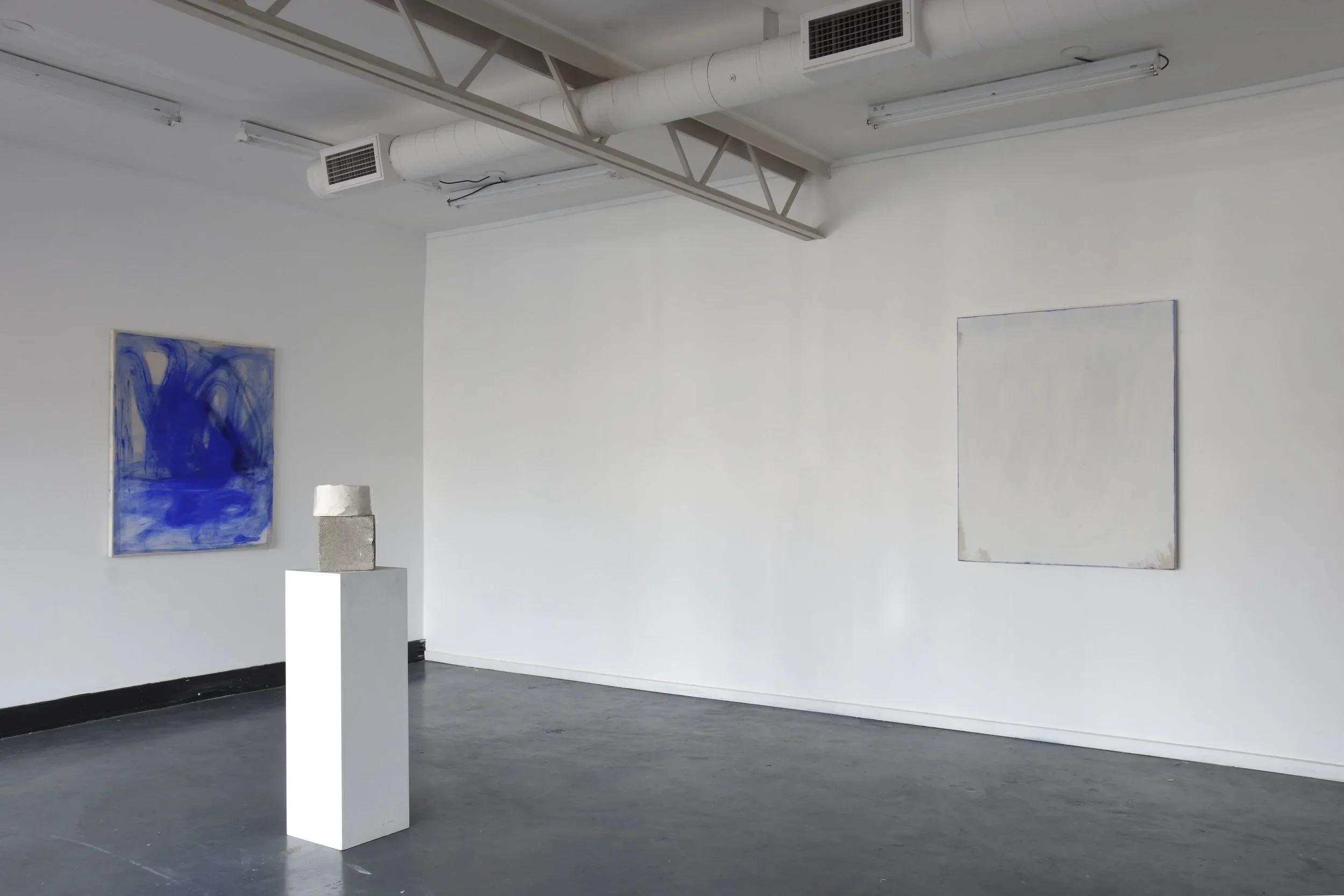
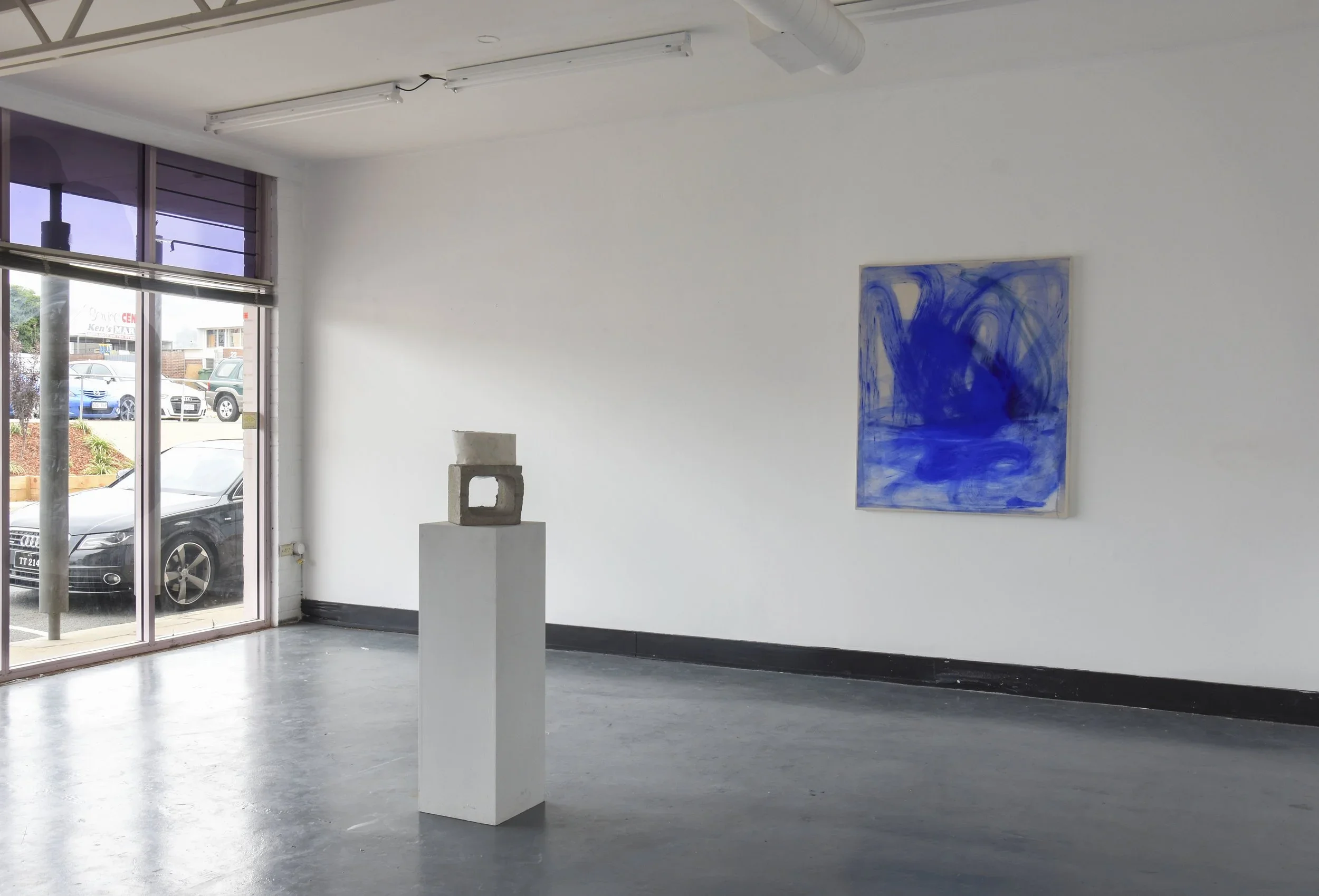
A lot of Skye Jamieson’s work billows. There’s a feeling of implied movement that continues somewhere while the forms painted (or printed) on the canvas (or silk) in front of you hold still. By implied movement, I mean actual, kinetic movement, probably in a space with dimensions similar to those depicted in the work you’re looking at. It is in this that (for me, at least) the first strong tension within Jamieson’s work appears – that of trying to define with certainty the scale of this movement occurring somewhere behind the scenes, the shape and size of the space involved, and the matter inside it as it shifts in ways only barely suggested by the image.
This struggle to define space is encouraged by both the material nature of these works, and the visual experience of them. The most prominent colour that appears to the viewer – that which arrests the eye – is the blue that Jamieson has layered over and through the varying whites and creams that form a relatively static background for the play of pigment. It is in this use of pigment that the materiality of these works becomes most apparent. The pigment is employed as a blue dust without the addition of a fixative or medium. This means that the substance is itself always to a certain extent unstable on top of the paint that frames or partially contains it. The material might leave the canvas at any time, even if only in the smallest amounts. This work might mark you by spreading itself outward to coat your lips or your fingers.
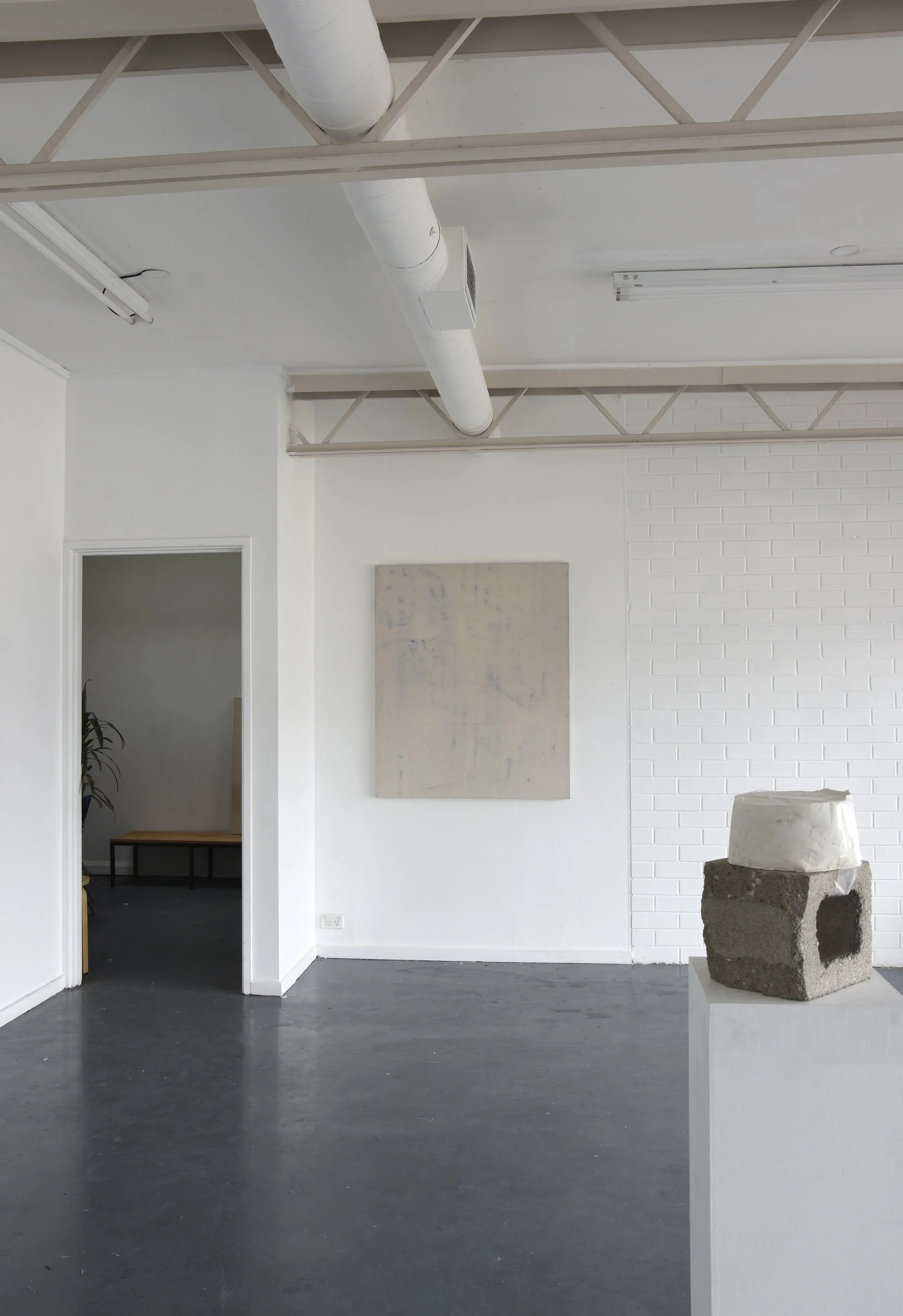
The second effect produced by Jamieson’s work that I will mention is the sense in which the viewer is also constantly re-oriented in terms of the physical space depicted, as distinct from the external space reached into by the possibility (threat?) of pigment dust, or the mysterious implied space I mentioned earlier. (And for those who want to argue the point here, there is a space depicted, although it may be harder to read as such than more mimetic representations of actual spaces.) Large patches of dense, vivid blue sit in a depthless two-dimensional plane; yet the individual patches of colour seem simultaneously shallower than the varying white background on which they are placed, and infinitely deeper, as if the viewer were somehow confronted with a hole in which the lightless black were a cool cerulean. Other works with a matte white finish, interrupted only by blue scorings on the edges of the canvas, feel like a space that is both occupied and empty, like a room in which you can suddenly feel the air, leaving you aware of the qualities of presence and transparency in the substance pressing gently against your eyes. The physical ridges and dimples of paint on canvas disclose their own topography, like a landscape seen from miles above; at the same time and through this landscape, an ambiguously welcoming or vacant space seems to expand outward in front of you.
The pigment I think most vividly reminds me of blue chalk lines I saw marked on clean concrete when I was much younger. I must have seen these lines while my Dad was using them to mark out on a concrete bed the outlines for some kind of cut; but maybe he was also just showing me how the tool that made them worked. I remember the shape of its orange steel casing (a bit like a fig), and I remember the brushed steel handle on the side of the tool, which I used to spin out the spool of the thread until it jammed. My Dad took the tool from me, opened the casing and spent maybe forty minutes (but maybe even longer) rewinding the thread, and covering his hands in clean blue chalk dust.
— Connor Drum