Blaze 13
15 February – 13 April, 2019
Curated by David Broker
Canberra Contemporary Art Space, Canberra
One of the artists in BLAZE THIRTEEN described their participation as "a big deal". It was always meant to be - an annual exhibition of emerging visual arts practice in the ACT and a 'best of' new artists from the previous year, in this instance 2018. Since 2006 when Leah Bullen, Karena Keys, Marina Nielson, Meg Roberts, Simon Scheuerle, Kate Smith and Charlie Sofo emerged onto the local and national art scenes, BLAZE has produced a growing archive of artists with their eyes on the future. Thirteen years later many of these names will be familiar to audiences across the country for like the exhibition itself, they are the among the stayers. In many respects BLAZE is a difficult exhibition, with little to hold it together other than the idea that all artists are emerging at roughly the same time. Once confined to the CCAS Studio Residency Program, consisting largely, but not exclusively, of Bachelor of Arts (Hons) Visual Arts graduates from the ANU School of Art and Design, in 2010 BLAZE spread its wings to take a more inclusive approach that focused on the artists exhibiting at venues such as Australian National Capital Artists, M16 Artspace, CCAS Manuka, Belconnen Art Centre and the odd Artist Run Initiative that popped up on the fringes of Canberra's active visual arts community.
Looking back through some of the past catalogues for BLAZE I was fascinated by the variance in work and approaches to exhibitions as each year goes by. Each iteration has focused the community's enthusiasm for artists who are warmly welcomed into what can be a recalcitrant society. BLAZE is a perfect storm of evolving technical expertise and exciting new ideas born partly of innocence and the desire to make an enduring impression in the vast and competitive milieu of creativity that greets all graduates from the sheltered confines of art school. The question arises for all new artists; how does one make a mark amidst this amorphous mass of creative enterprise where technique alone will not suffice? Perhaps another factor that loosely binds the artists in exhibitions such as BLAZE, where the curators' role is unusually distanced, is a sense of self. All five artists in BLAZE THIRTEEN, Dean Cross, Skye Jamieson, Alex Lundy, Shags and Joshua Sleeman-Taylor have invested something of themselves into their works. While this is not unusual in the arts, the ability to translate self-reflection into form can be the difference between making a lasting impression and none at all.
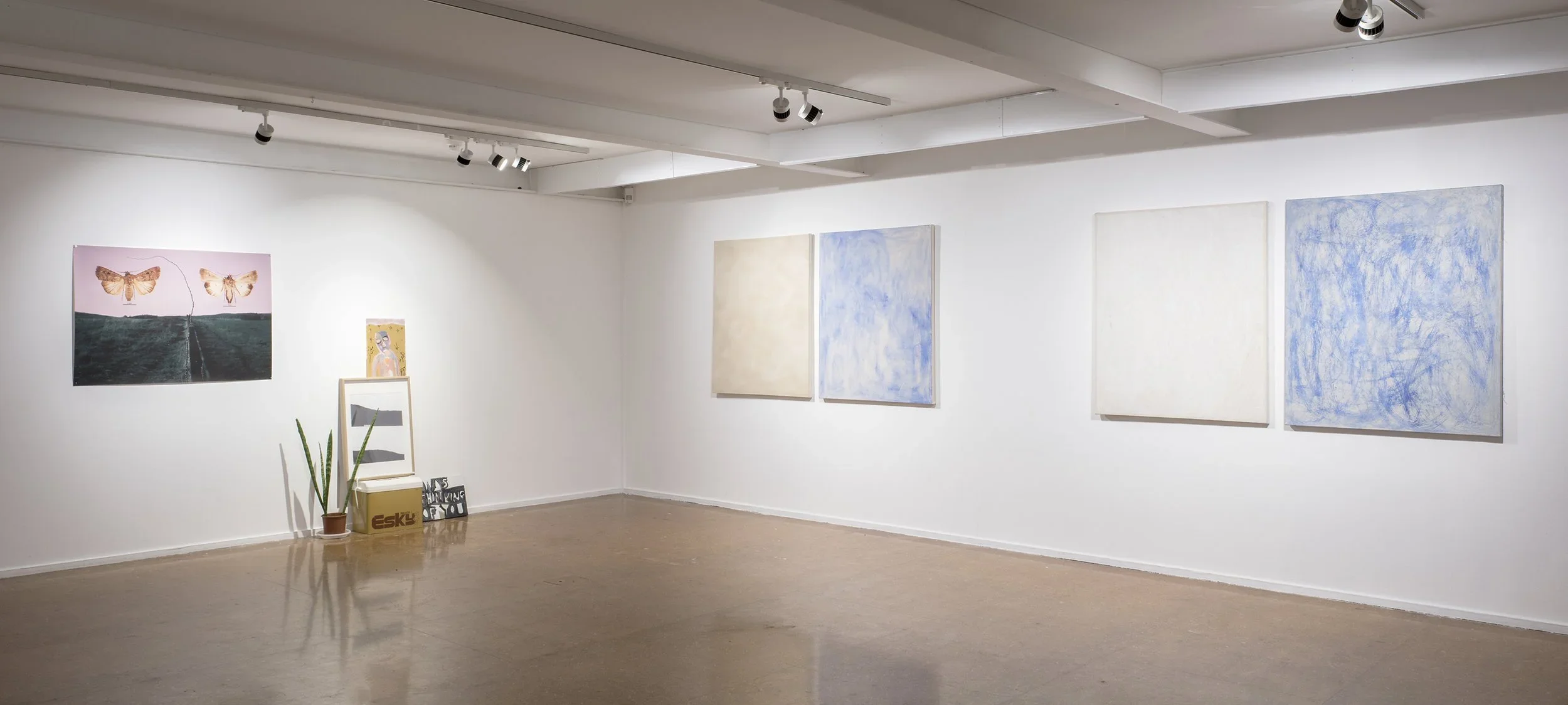
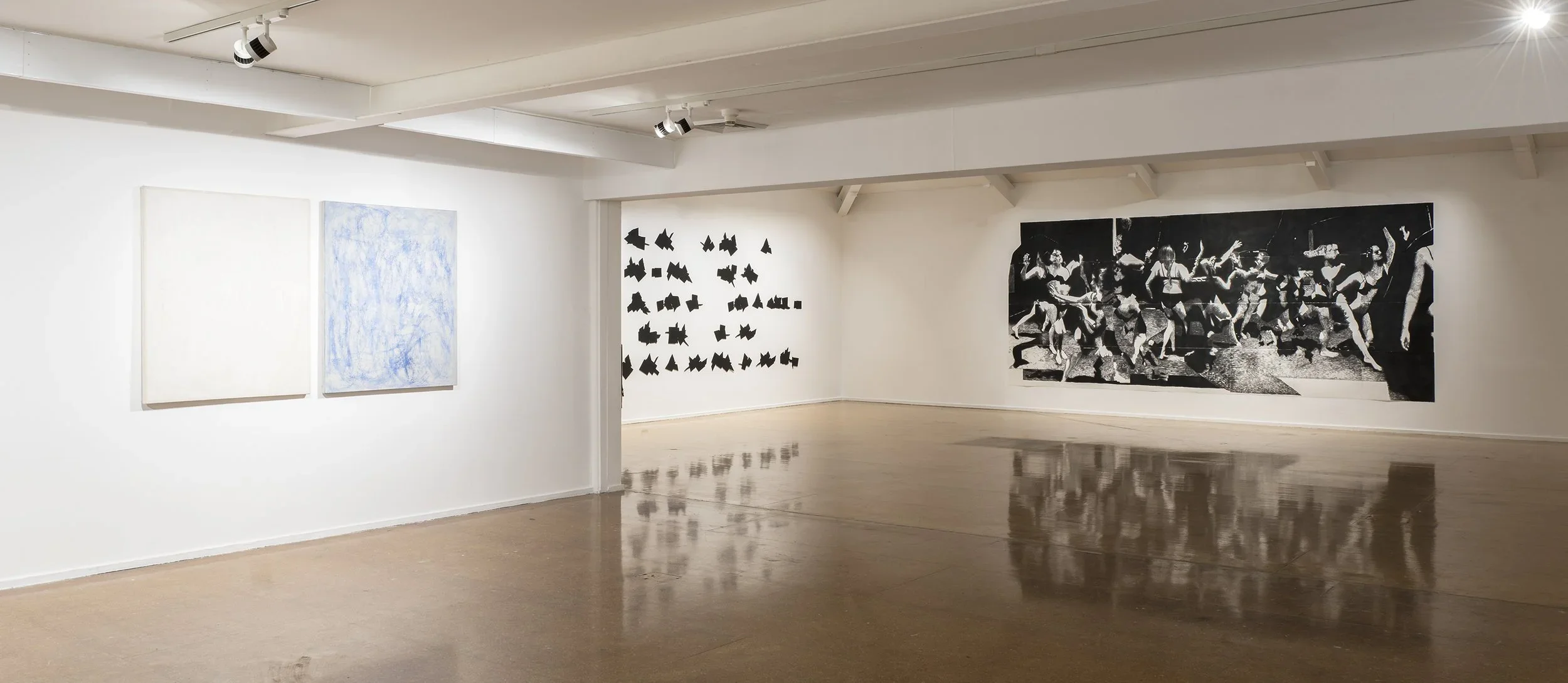
BLAZE THIRTEEN brings together five artists who have participated in exhibitions around Canberra (and some interstate) over the past year - in Contour 556, at CCAS Manuka, Tributary Projects, Canberra Grammar School, Belconnen Art Centre and Megalo Print Studio + Gallery. The work, however, is new: produced over Christmas and New Year (2018-19) to reach completion near the time of the opening. BLAZE THIRTEEN is straight off the drawing board if not created in the gallery itself, and driven by a curator's predisposition to discover connections and links between artists and works I immediately attempted to produce a kind of gestalt that is perhaps futile and unnecessary. Against that grain, however, I note that four out of the five artists have emerged from the Printmedia and Drawing Workshop at the ANU School of Art and Design and one, Dean Cross, completed his Honours degree in the Sculpture Workshop. The works are overwhelming monochromatic with a small amount of blue; only Cross has added colour and it is economical. And then there are the personal distinctive identity issues that distinguish the works while the artists simultaneously attempt to avoid excess subjectivity.
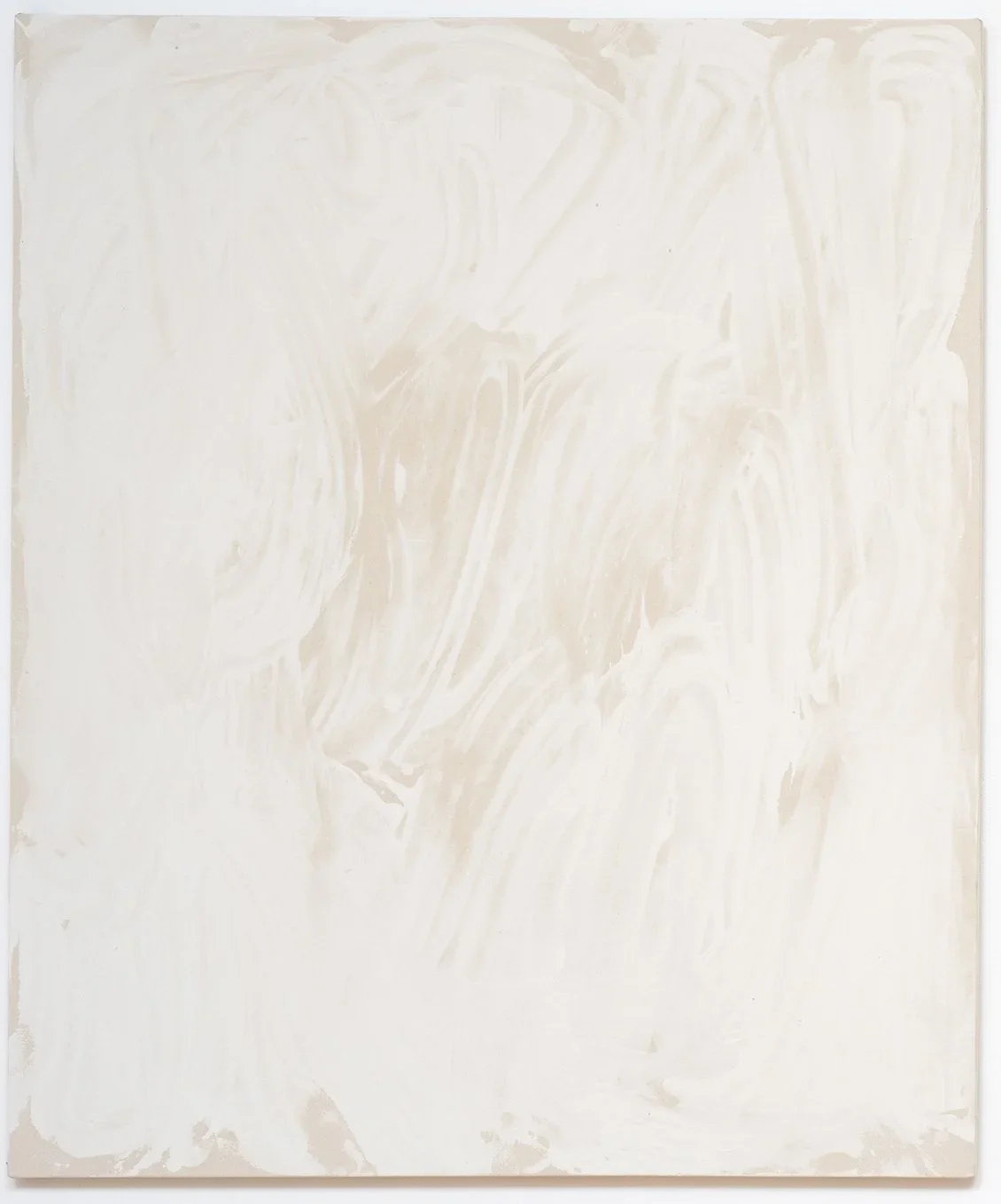
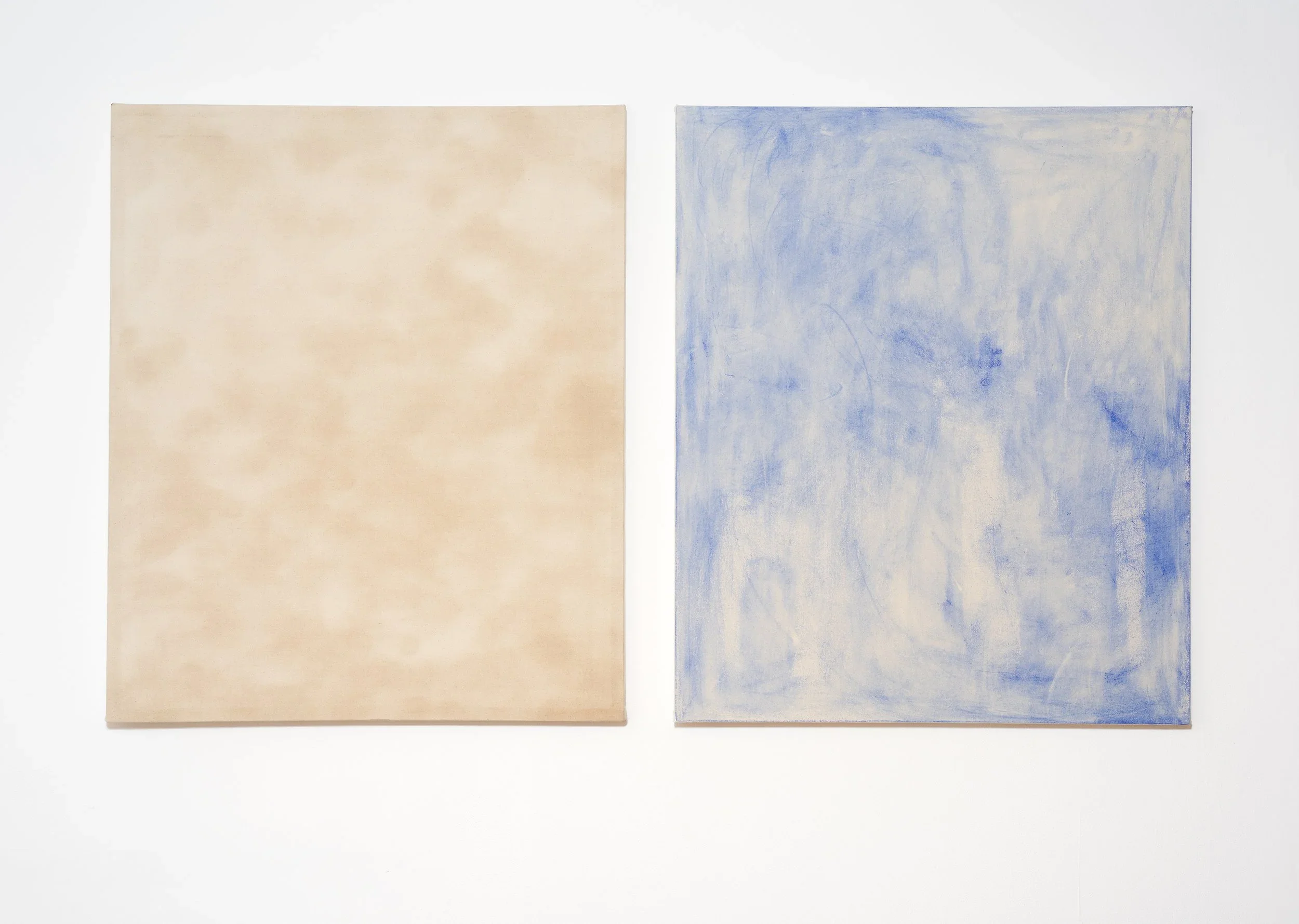
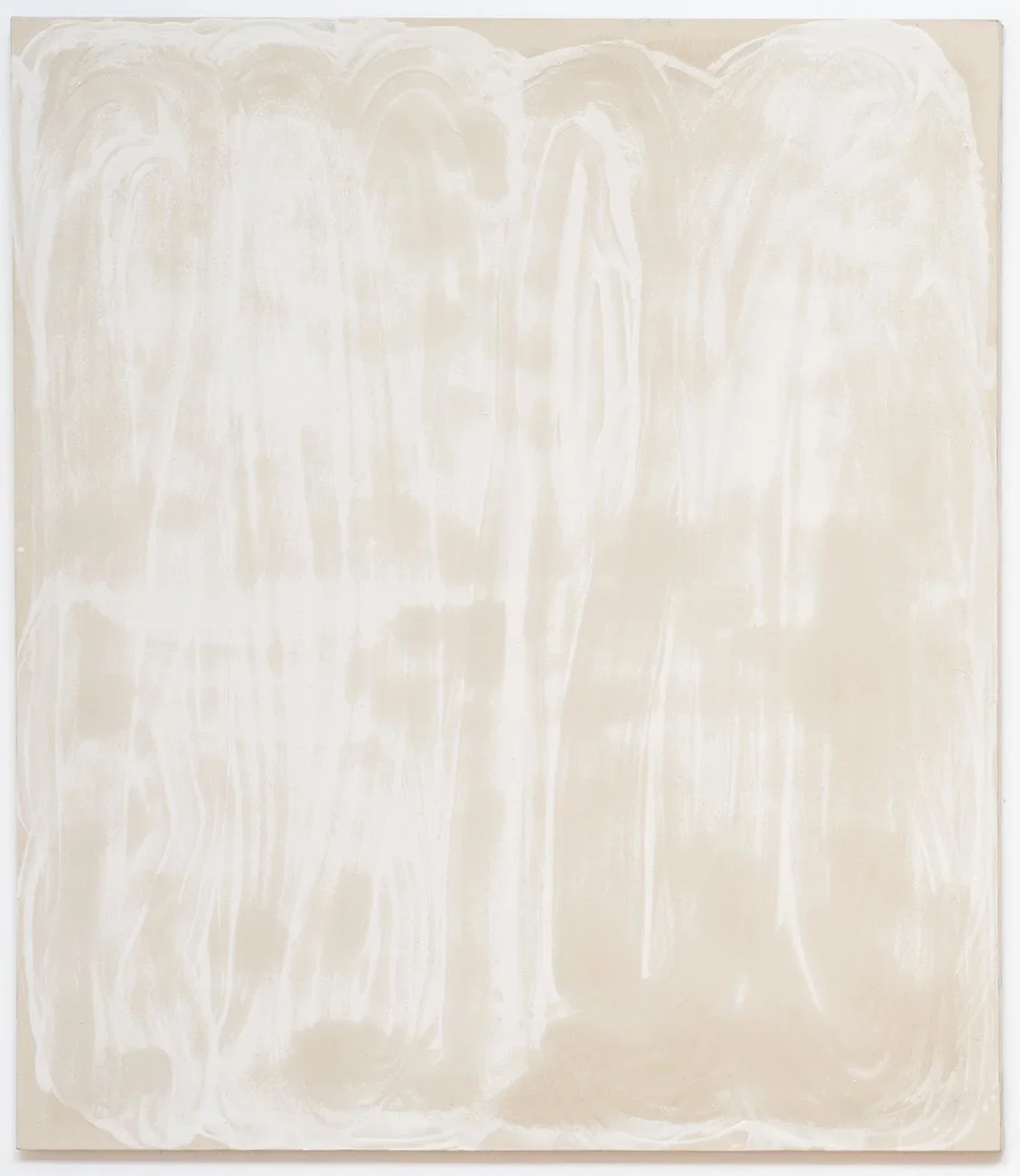
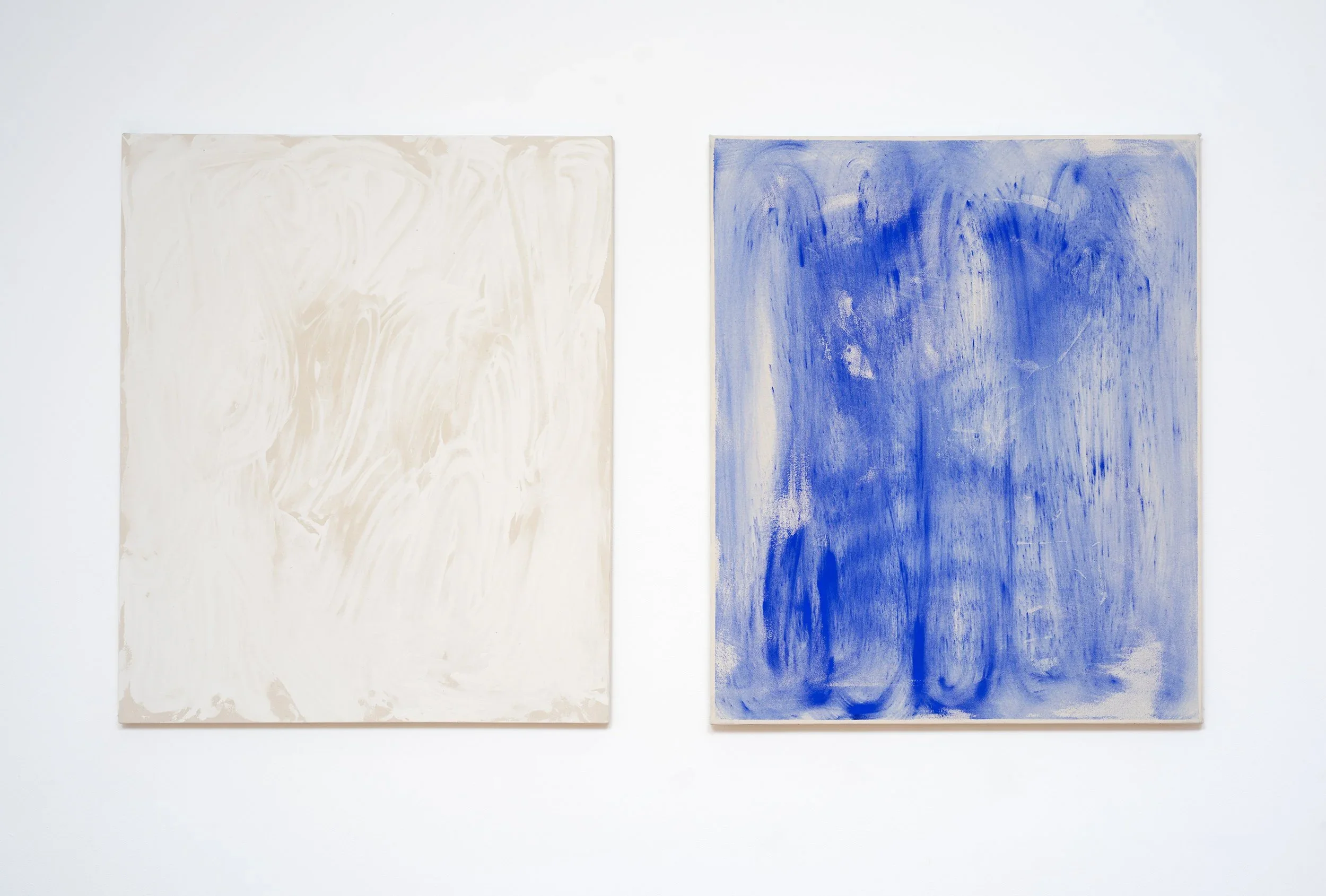
Working with olive oil, pure pigment, oil paint and china clay, Skye Jamieson's paintings are moulded and shaped to reveal immediate impressions of her environment. Each of four diptychs is a psychogeographic exploration
'documenting' Canberra's cityscape as she drifts through the streets in a state of acute awareness. Jamieson's approach can be linked with the Situationists' (1957-1972) idea of dissolving the boundaries between life and art, and her every work is a journey of discovery in which she has exchanged distance for depth. As is the case with many forms of abstraction, the ways that Jamieson's paintings connect with audiences depends on her ability to communicate feelings and to present views of the city that are not pictorial but emotional. These minimal pieces, the result of much experimentation with unfamiliar materials, are a slow burn as Jamieson eschews drama for the quiet intensity that has characterised her work to date. In their succinct subtlety she distracts and seduces an audience overwhelmed by the glamour of consumerism, such as television and computer games) ultimately providing welcome relief from the pace and pressures of everyday life. Jamieson's new work proposes inventive strategies for exploring the city, or any other inhabited space, by straying from predictable paths and inspiring awareness of intuition as a catalyst for cognizance.
Jamieson's unique brand of abstraction with patches of blue also owes a little (but less than usual) to Yves Klein and the Nouveau Réalisme movement (1960s), noted for finding new ways of presenting and perceiving reality.
The approach of both the New Realists and the Situationists connects directly with the discovery of familiar things we encounter in the streets, but don't necessarily notice. The challenge for artists such as Jamieson therefore, is to find innovative ways of seeing the ordinary. Thus the fluidity achieved through her ostensibly free-form manipulation of china clay juxtaposed with adjacent blues, mimics the flow of water, a recurrent presence in Jamieson's work.
Acutely aware of her physical relationship with water through, for instance, puddles, drains, dew and sprinklers, she strips her environment to reveal observations of presence and absence, positive and negative, in worlds where the natural and artificial converge. The properties of flowing water might also stand as a metaphor for the ways that Jamieson and her audience come together, in an essentially tranquil place, free of modernity's ambient noise, where the artwork flows over and immerses the viewer in a state of calm disquiet.
THIRTEENis not my first BLAZE. After several years I returned with the knowledge that this generic annual exhibition poses challenges for curators that ultimately result in a satisfying experience. Working with a limited pool of artists places restrictions on the scope of the exhibition, however, it also encourages the curator and artists to overcome any perceived limitations. With new artists, in the case of BLAZE THIRTEEN only one year from art school, the exhibition is forged in an atmosphere of excitement where participants see it as an opportunity to make their mark.
Even in the absence of an initial overriding concept this working partnership offers certain freedoms and coherence comes from unlikely places. Discussions take place around what artists plan to do while a sense of camaraderie and ownership develops with the intention of creating a knockout exhibition. At the outset we talked about ways that all five artists drew upon modernism to a greater degree than most contemporary artists. There are more than traces of Bauhaus, Picasso, Duchamp and Klein to be found in this exhibition but in the search for cohesion it was colour (or lack of it) that brought it together. This was not a change of direction for the artists, but rather provided a point where everyone could work as a cohesive unit. This sense of collective activity frames BLAZE THIRTEEN, unifying a range of technical and conceptual pursuits in ways that continue to cement the prestige of Canberra's much-anticipated showcase of emerging art.
David Broker
March 2019